Care and Cleaning of Upholstery, Screen and Health Care Fabrics

 Download PDF version

With proper care and cleaning, wool, synthetic and blended upholstery fabrics will maintain their appearance for years, although some synthetics tend to hold the dirt more and may require more frequent cleaning.

The general rule with STAINS is the longer it's been there, the harder it is to remove, so regular light vacuuming will quickly remove any dust and fluff. More intensive cleaning will be required from time to time and should be done by professional cleaners. Dry cleaning is the safest method for wool products and probably the best for synthetics and blended fabrics as long as there are no adverse reactions with the solvent.

Detailed information on the removal of stains from wool fabrics is available from the website of the Woolmark Company at www.woolfurnishings.com

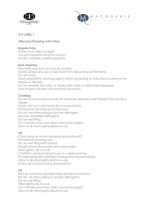
The Commercial Textiles Association (CTA) provides aftercare labels that are affixed to most upholstered fabrics and provide guidelines for the care, spot cleaning and cleaning of fabric for upholstered furniture. These general guidelines are supplied by the CTA in their booklet, Standard Aftercare Labels for upholstered furniture. The two labels relating to Macquarie Textiles Solutions are 1 and 3 shown here.


It is recommended that environmentally preferable maintenance solutions are used and you should ensure that your professional cleaners are experienced in cleaning textile products with environmentally friendly products.

Methods of Care and Cleaning Upholstery and Screen Fabrics

All these methods apply equally to wool or synthetic or blended fabrics. There is generally enough detail on the CTA labels to provide sufficient care and cleaning instructions.

1. ROUTINE CARE
Routine care of vacuuming can minimise the need to clean upholstered furniture.

2. SPOT CLEANING.

Spot cleaning can restore locally soiled areas and can be done with a sponge and either wool detergent, shampoo or dry cleaning fluid. Always test on concealed area to ensure there is no colour change caused by the cleaning method. Sponge again with clean water and then allow to dry (avoid direct sunlight).

3. DRY CLEANING

Dry cleaning is a method of cleaning which involves the use of organic solvents and detergent solutions. The cycle of spraying and extraction is so quick the solution do not have time to penetrate the filling and thus does not leave the fabric or filling .wetted out.. The process is carried out with specialized equipment and should be done by a professional.

4. SHAMPOO CLEANING

This method of cleaning uses a foaming detergent solution to effect the cleaning and is generally a hand process. Despite its simplicity, shampoo cleaning requires considerable skill if it is to be successful.

Shampoos may be purchased in aerosol cans (shampoo foam) or they are available as a concentrated detergent, which is diluted with water. The detergent solution is applied to the upholstery by means of a clean cloth or sponge.

It is essential that only upholstery shampoos be used. Other detergents formulated for other purposes (e.g. laundry, dishwashing) often produce unusual residues, which may lead to acceleration of soiling.

The technique for applying the shampoo to the fabric is equally important. Excess water must be avoided, too much water means the interior of the furniture will become wet causing excess drying times, mildew and odours and may cause soil to migrate from the interior of the furniture to the surface of the fabric. Finally, scrubbing can produce a hairy surface.

5. HOT WATER EXTRACTION

Hot water extraction (sometimes called steam cleaning) is also a machine process very similar to dry cleaning except that a solution of hot water and detergent is used.

This process involves a machine applying a hot detergent solution to the fabric and then extracting it before it penetrates the filling. This process does not apply steam to the fabric, as the common expression would apply. This process has the risk of over wetting, for this reason alone consumers are well advised to have this process performed by an experienced tradesman.

6. SOIL RESIST TREATMENTS

Many fabrics are treated either by the textile manufacturer, the furniture manufacturer, the retailer, or by independent applicators with special chemicals to impart a soil resistance quality to the fabric. These chemicals are also often available for the treatment of finished items of furniture.

The presence of a soil resist treatment will generally require a modification of the care instructions to be applied to a fabric. The CTA label 3 cover fabrics treated with soil resistant finishes.

Methods of Cleaning EDEN Collection Fabrics

Fire retardant polyester fabrics can be laundered or dry cleaned professionally with ease, the fire retardancy is inherent in the fibre and as such is not altered by any form of cleaning.

1. Laundering

Commercial laundering is often used for the cleaning and steralisation of these products and temperatures up to 110 °C will not affect the performance of this material. Cooling quickly after hot washing can cause permanent creasing of the fabric due to thermal shock. It is always important in any laundering and drying operation that the machines are not overloaded as this will detract from the efficiency of these machines. The best alternative is to seek professional advice on the laundering options available.

2. Dry Cleaning

Commercial dry cleaning of these fabrics is also a viable alternative but is probably a much dearer option.

* Macquarie Textiles Solutions provides the information in this section in good faith. Macquarie Textiles Solutions accepts no responsibility for any claim arising from the treatments proposed. If in doubt, please contact professional cleaners for advice.